
The Google Algorithms Nobody Talks About (But Every Marketer Should Know)
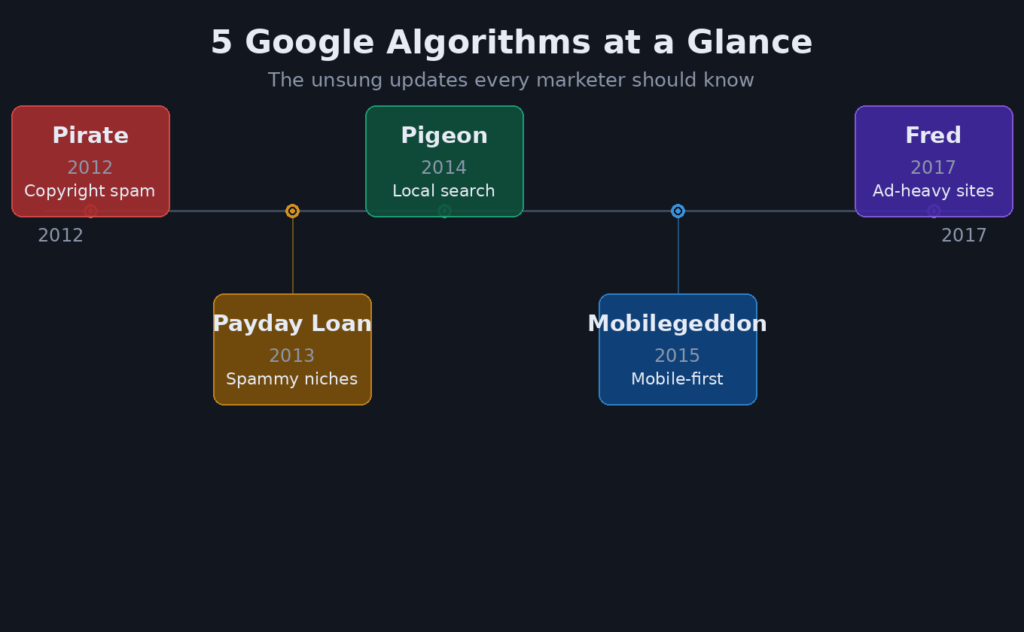
You’ve probably heard the big names, Panda, Penguin, BERT. They get all the SEO glory. But Google’s been quietly rolling out a whole other cast of algorithm updates that are just as important, just as sneaky, and just as capable of tanking your traffic overnight.
So let’s talk about the five algorithms that don’t get enough credit and what they mean for your digital marketing content strategy right now.
Pirate (2012) The One That Hates Copyright Thieves
Launched in August 2012, Google’s Pirate update was built to penalise websites with repeated copyright infringements, specifically those racking up DMCA complaints. Research later revealed the Pirate update can cause up to an average 89% drop in search traffic for sites it targets. That’s not a ranking dip. That’s a cliff.
If you’re running a content site, this is your reminder: original content isn’t just good practice, it’s survival.
Payday Loan (2013) The Niche-Specific Nightmare
Unlike most updates that sweep across the whole web, the Payday Loan update was query-specific, it aimed to clean up particularly spam-prone search terms like “payday loans”, “online rummy cash games”, or “instant gambling bonuses” by applying stricter ranking criteria only when those queries were entered.
Casinos, online card game platforms, debt consolidation sites, and high-competition financial niches were among the hardest hit.
If you’re operating in a high-competition, traditionally spammy niche, this update is still quietly working against you.
The fix? Build real authority. Create content that actually helps people, not content designed to trick the algorithm.
Pigeon (2014) The Local SEO Game-Changer
Introduced in 2014, the Pigeon update was designed to improve Google’s local search results with enhanced business listings, reviews, and geo-signals playing a bigger role.
It caused fluctuations in local “7-pack” results, with some businesses vanishing and others taking their place based on stronger organic SEO. Directory sites like Yelp also regained prominence in many local queries.
If you’ve ever wondered why Google My Business matters so much, this is the update that made it essential. Your NAP (Name, Address, Phone), your reviews, your local backlinks, Pigeon is watching all of it.
Mobilegeddon (2015) The Update That Changed Web Design Forever
The name alone tells you Google meant business. This mobile-friendly update, announced in 2015, introduced mobile UX quality as a new positioning factor for mobile search, a shift driven by the significant increase in searches being carried out from mobile devices.
While it didn’t destroy rankings across the board as some predicted, it had a clear long-term impact: responsive design became standard, and mobile usability a core SEO requirement.
Today, Google runs mobile-first indexing. Mobilegeddon wasn’t a warning shot, it was the beginning of a full takeover.
It caused fluctuations in local “7-pack” results, with some businesses vanishing and others taking their place based on stronger organic SEO. Directory sites like Yelp also regained prominence in many local queries.
If you’ve ever wondered why Google My Business matters so much, this is the update that made it essential. Your NAP (Name, Address, Phone), your reviews, your local backlinks, Pigeon is watching all of it.
Fred (2017) The Ad-Heavy Site Killer
Fred got its name from a joke. The SEO community nicknamed this update “Fred” after a quip from Google’s Gary Illyes, who half-jokingly proposed naming every future Google update “Fred.” The label caught on fast. The pain did too.
Fred targeted sites that focused on ad revenue over content quality. Sites with aggressive advertising, content with low added value, and poor user experience all took heavy hits. Blogs built around affiliate links and thin articles were decimated.
The lesson is simple and it hasn’t changed: if your website exists to serve ads, Google will eventually notice. Put your users first.
What All Five Have in Common?
Look at these five updates side by side and a pattern emerges. Google isn’t just rewarding good content, it’s actively punishing anything that gets in the way of a good user experience. Copyright theft, spammy niches, poor mobile design, ad-cluttered pages, they’re all versions of the same problem: websites that exist for everyone except the actual reader.
The good news? If you’re creating real content, for real people, on a site that actually loads well on a phone, you’re already winning.
For for info on how I work around SEO visit here.
Great content! Keep up the good work!
Glad you found it useful, thank you so much!